Open Quantum Workbench · FAST University
Write quantum circuits in the framework you already know.
Qiskit, Cirq or PennyLane in. OpenQASM 3.0, a circuit diagram and measurement counts out, in one browser tab.
from qiskit import QuantumCircuit qc = QuantumCircuit(2, 2)qc.h(0)qc.cx(0, 1)qc.measure([0, 1], [0, 1])Circuit
OpenQASM 3.0
Counts
1,024 shots
- |00⟩0
- |01⟩0
- |10⟩0
- |11⟩0
Run it, then read the noise.
Step through a circuit one moment at a time. The bars show the exact probabilities so far; at the end, compare them with what 1,024 real shots on the QCanvas simulator returned.
Two qubits, one Hadamard and one CNOT.
- |00⟩50%522
- |01⟩0%0
- |10⟩0%0
- |11⟩50%502
Ideal is 50% each for |00⟩ and |11⟩. The run returned 522 and 502: that gap is shot noise, not an error. |01⟩ and |10⟩ never appear because the qubits are entangled.
Measured: one 1,024-shot run on the QCanvas simulator (Qiskit backend). Bit order q0 first.
One circuit, three frameworks
Same circuit. Same gates.
Each framework compiles to OpenQASM 3.0, so you can switch syntax without relearning the circuit.
from qiskit import QuantumCircuit qc = QuantumCircuit(2, 2)qc.h(0)qc.cx(0, 1)qc.measure([0, 1], [0, 1])import cirq q0, q1 = cirq.LineQubit.range(2)circuit = cirq.Circuit( cirq.H(q0), cirq.CNOT(q0, q1), cirq.measure(q0, q1),)import pennylane as qml dev = qml.device("default.qubit", wires=2) @qml.qnode(dev)def bell(): qml.Hadamard(wires=0) qml.CNOT(wires=[0, 1]) return qml.counts()OPENQASM 3.0;include "stdgates.inc"; // Quantum and classical registersqubit[2] q;bit[2] c; // Circuit operationsh q[0];cx q[0], q[1];measure q[0] -> c[0];measure q[1] -> c[1];Qiskit and Cirq produce identical QASM.
A path through the workshop
Six real templates, ordered from a single entangled pair to a parameterised circuit. Each one opens in the editor, ready to run.
- 01BeginnerQiskit
Bell state
A Hadamard and a CNOT entangle two qubits. The histogram shows only 00 and 11, in roughly equal parts.
- 02IntermediateQiskit
Deutsch-Jozsa
A balanced oracle on three input qubits and one ancilla. One query later, the inputs always read 111.
- 03IntermediateQiskit
Quantum teleportation
A Bell pair is shared between q1 and q2, then q0 and q1 are Bell-measured and all three qubits are read out.
- 04IntermediateQiskit
Grover's search
A two-qubit search that marks |11> with a CZ oracle, then amplifies it with a diffuser. The result is 11.
- 05AdvancedQiskit
Quantum Fourier transform
Three qubits, Hadamards and controlled-phase rotations, then a swap to reverse the qubit order.
- 06AdvancedPennyLane
Variational circuit
A two-qubit ansatz: RY on each qubit, a CNOT, then RZ on each, with the angles held in a params array.
Inside the workbench
Write, convert, simulate and inspect a circuit without leaving the page.
A real code editor
Monaco with completions for Qiskit, Cirq and PennyLane. Files and projects are saved to your account.
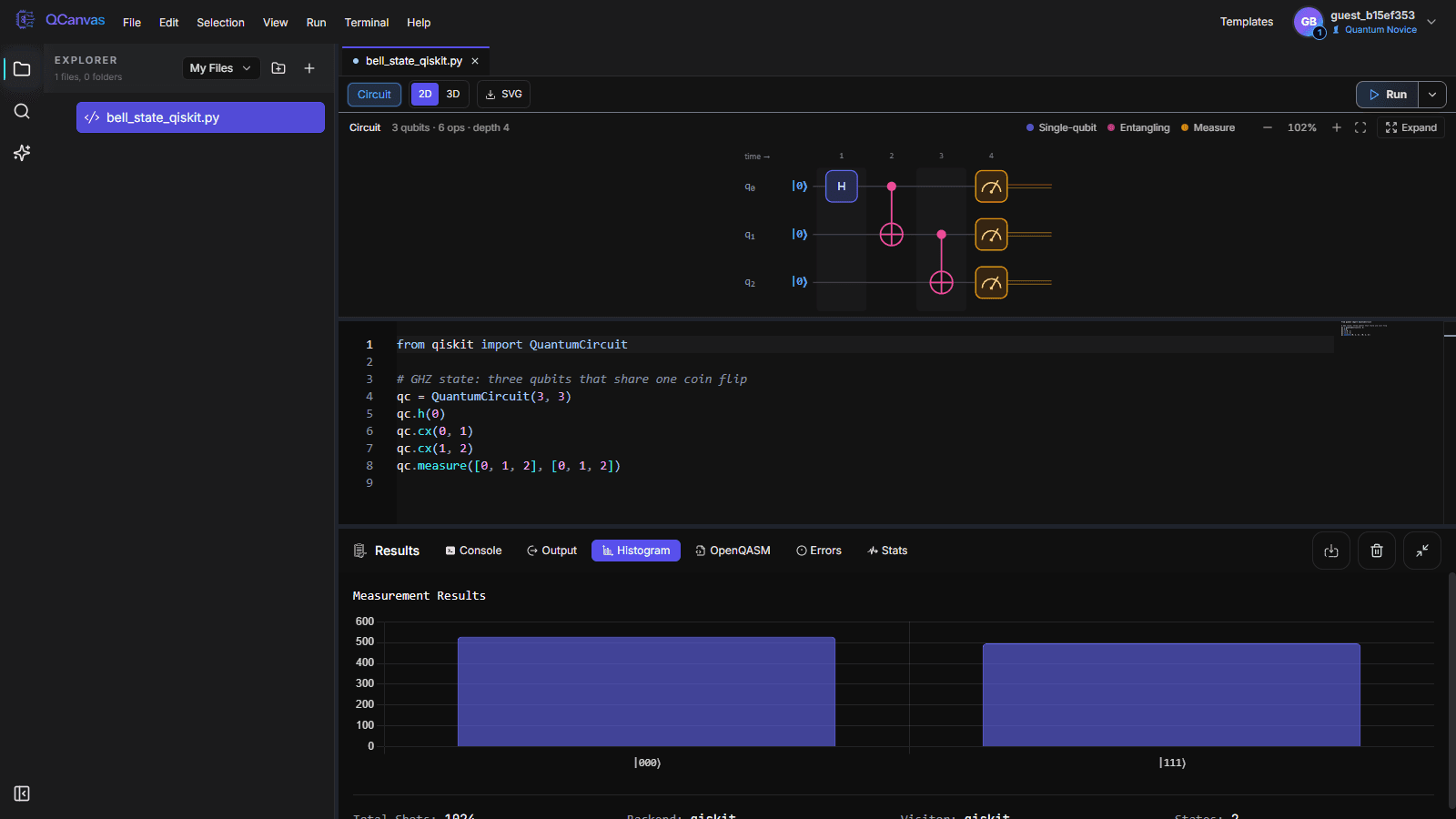
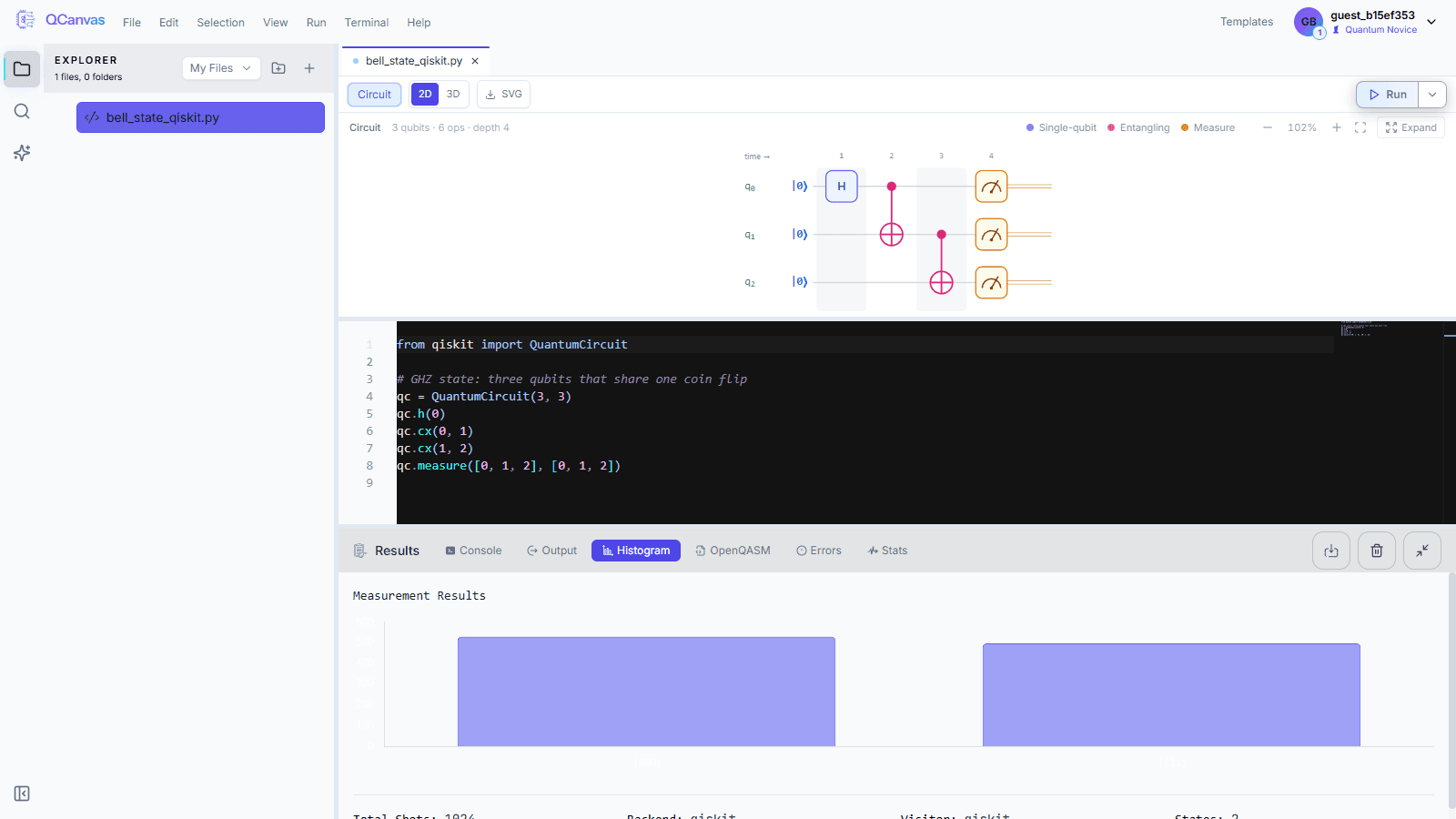
Three simulators
The same OpenQASM program runs on the Cirq, Qiskit and PennyLane backends. Every shipped example passes on all three.
- Qiskit
- Cirq
- PennyLane
Circuit diagrams in 2D and 3D
Switch to a 3D view, hover a gate for its details, and export the diagram as SVG.
OpenQASM 3.0 export
OPENQASM 3.0;include "stdgates.inc";qubit[2] q;bit[2] c;h q[0];cx q[0], q[1];measure q[0] -> c[0];measure q[1] -> c[1];Copy it or download it as a .qasm file.
No account needed
Try it without an account
Guests get a private workspace of their own. It is deleted when you log out or after 3 days.
Docs and resources
Start with our docs, then go to the source for each framework and the standard.
- QCanvas docsGuides and API
- ExamplesRunnable circuits
- Source on GitHubRead and contribute (opens in a new tab)
- OpenQASM 3.0 specificationopenqasm.com (opens in a new tab)
- Qiskit docsdocs.quantum.ibm.com (opens in a new tab)
- Cirq docsquantumai.google/cirq (opens in a new tab)
- PennyLane docsdocs.pennylane.ai (opens in a new tab)
Open the editor and run your first circuit.
Built at FAST University as part of Open Quantum Workbench. Free for coursework, workshops and your own experiments.